This structured table cross-references unique claim numbers for windshield repairs and collision-related auto damage filings. It is designed for policyholders to organize their auto insurance claim files without mixing incident types that are processed under separate policy provisions. All numbers included here are for illustrative filing use only, and you must confirm official claim identifiers directly with your insurance provider or assigned adjuster before updating your personal file folder. This resource is built for personal record-keeping only, and does not constitute coverage confirmation or claims adjustment advice.
Claim number table column for windshield damage claim entries
This column is reserved exclusively for the official, insurer-issued alphanumeric claim ID assigned to glass-only damage events, including chips, cracks, or full windshield replacement that is not directly caused by a covered collision impact. Many insurers tag comprehensive glass claims with a unique identifier in the claim number, such as a leading GL prefix or trailing -GL suffix, to distinguish these filings from collision, property damage, or liability claims in their internal systems. When logging entries in this column, copy the full claim number exactly as it appears on your official claim confirmation email, letter, or text message from your insurer, avoiding any abbreviations or edits that could cause confusion when you reference the number with repair shops or adjusters. You may add adjacent sub-columns for supporting details specific to the windshield claim, such as the date the damage was first noticed, the name and contact information of the glass repair vendor you selected, the amount of your comprehensive deductible that applies to the claim, and the date the repair or replacement was completed. This column is not intended for claim numbers related to glass damage that occurs as part of a larger collision event, as those glass repairs may be bundled under your collision claim or assigned a separate linked glass claim number that will be cross-referenced in the matching column of the table.

Collision claim file folder with assigned numeric claim identifiers
Your physical or digital collision claim file folder should be clearly labeled with the full, official collision claim number issued by your insurer for damage resulting from impacts with another vehicle, stationary object like a guardrail or tree, single-vehicle rollover events, or impacts with debris on the roadway that causes structural or body damage beyond just glass. The claim number should be printed on the front tab of the physical folder, and included in the file name of your digital folder and every supporting document stored inside, including police reports, photographs of the collision scene and vehicle damage, written estimates from licensed body shops, correspondence with assigned adjusters, rental car receipts, and medical billing records if you sustained injuries in the collision. Collision claim numbers are often tagged with a COL prefix or -COL suffix in insurer systems, but you should always use the exact identifier provided to you rather than modifying the number to match a perceived pattern. If a single collision event causes both structural body damage and a cracked or shattered windshield, your insurer may assign two separate claim numbers for the same incident: one for the collision damage, and one for the glass repair, which is why maintaining separate folders for each claim type and cross-referencing their numbers is critical to avoid lost paperwork or delayed processing.
Matching cross-reference form linking glass and collision claim codes
The core of this cross-reference form is the table below, which lets you log all glass and collision claim numbers in a single, sortable document to track which numbers correspond to which incident, whether the claims are linked to the same event, and their current processing status. All sample claim numbers included are for illustrative teaching purposes only, and you should replace them with the official identifiers issued by your insurance provider.
| Cross-Reference ID (Internal Filing Use Only) | Windshield Claim Number (Official Insurer Issued) | Collision Claim Number (Official Insurer Issued) | Incident Date | Linked Incident Flag (Y/N) | Claim Filing Status |
|---|---|---|---|---|---|
| AUTO-2024-001 | Illustrative example: GL-789452-24 | N/A | 2024-01-12 | N | Closed / Paid |
| AUTO-2024-002 | Illustrative example: GL-792108-24 | Illustrative example: COL-348192-24 | 2024-02-27 | Y | In Progress / Adjuster Review |
| AUTO-2024-003 | N/A | Illustrative example: COL-351077-24 | 2024-03-14 | N | Open / Awaiting Body Shop Estimate |
| AUTO-2024-004 | Illustrative example: GL-801446-24 | N/A | 2024-04-03 | N | Open / Awaiting Glass Repair Confirmation |
You can add additional rows to this table as you file new claims, and update the status column every time you receive a new update from your insurer, repair shop, or adjuster. Print two copies of the completed table: keep one in the front of your windshield claim sub-folder, and the other in the front of your collision claim master folder, so you can quickly look up the correct claim number without flipping through multiple pages of supporting documentation. You may also share a redacted copy of this table with your insurance broker or licensed agent if you work with one, to help them follow up on your claim status on your behalf. Clause Shelf provides this organizational resource for personal record-keeping only, and it does not bind coverage or modify any terms of your auto insurance policy.
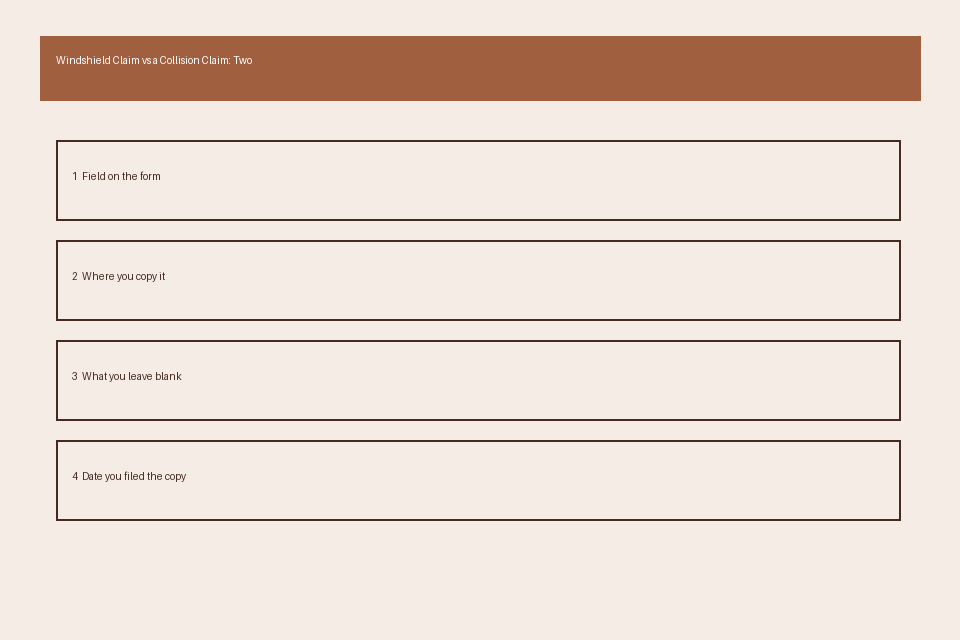
Reference number lookup box for sorting claim type numeric values
The reference number lookup box is a dedicated, easily accessible section of your physical or digital claim folder that lists only the active claim numbers sorted by type, to eliminate confusion when you need to provide a claim number to a vendor or insurer representative. For physical folders, this can be a clear plastic card sleeve taped to the inside of the main folder cover, holding a printed one-page list that separates all windshield claim numbers from all collision claim numbers, with their corresponding internal cross-reference IDs and incident dates. For digital folders, this can be a pinned text file or note in your cloud storage folder that is formatted to be easily searchable, so you can pull up the correct claim number in seconds when you are on a call with your insurer. To make the lookup box even more functional, use color coding to distinguish claim types: highlight all windshield claim numbers in light blue, and all collision claim numbers in light yellow, so you can visually identify the correct number at a glance without reading through the full list. This sorting system prevents common filing errors, such as providing a collision claim number to your glass repair shop, which can lead to delayed payment for your repair or incorrect application of your collision deductible to a glass claim that may have a separate or waived deductible.
Policyholder notification note listing paired claim number assignments
The policyholder notification note is a one-page document you create to notify all relevant parties of paired claim numbers when a single incident results in both a windshield claim and a collision claim. The note should include your full legal name, your full auto insurance policy number, the date and location of the incident, the full official windshield claim number, the full official collision claim number, and a clear breakdown of which damages are covered under each claim number. For example, the note may state: “Windshield claim GL-792108-24 covers the full replacement of the front driver-side windshield sustained in the 2024-02-27 collision with a metal guardrail on I-95 northbound. Collision claim COL-348192-24 covers all other vehicle damage from the same incident, including front bumper replacement, frame alignment, and headlight repair.” You should provide a signed copy of this note to every vendor working on your vehicle, including the glass repair shop and the body shop handling collision repairs, so they know which claim number to use when submitting their invoices to your insurer. You should also attach a copy of this note to every email or letter you send to your insurer or adjuster regarding either claim, to prevent the insurer from mixing up the two claims, applying the wrong deductible, or incorrectly marking one claim as closed when it is still in progress. Keep a signed copy of the notification note in both your windshield and collision claim folders for your personal records.
Print a blank copy of the cross-reference table included on this page, fill in any open or recent auto claim numbers you have on file, and store it in the front of your auto insurance claim folder before your next call to your insurance provider.