
This comparison breaks down key functional differences between plan amendment pages and the auto insurance booklet you received. Mismatches between these two documents are a top cause of avoidable auto insurance claim processing delays, so aligning them before you file a claim or adjust your coverage reduces administrative friction and prevents coverage disputes. This guidance is designed for personal use in organizing your auto insurance claim file folder, and Clause Shelf provides these process steps for reference only, with no authority to bind coverage or resolve claim disputes. All coverage questions should be directed to your licensed insurance agent, insurer policy services team, or state insurance regulator.
Amendment page signature box alignment guidelines
All formal auto insurance plan amendments require valid signatures from two authorized insurer representatives to be considered legally valid, per most state insurance rules, and signature box alignment is a key marker of a properly filed, legitimate amendment. First, signature boxes on the amendment page must line up with the designated signatory roles listed on the final signature page of your original policy booklet; no cross-filled roles are permitted, meaning a claims adjuster cannot sign in the box reserved for a licensed underwriter, for example. Second, all signature boxes must sit within the 1-inch margin required for state-filed insurance documents; if a signature box is placed outside of this margin, you may request a corrected amendment copy before adding your own signature (if required for the change) to ensure the form is considered valid for future claims. Third, if you receive a digital copy of an amendment, confirm that the metadata associated with each signature box matches the signatory’s official insurer email domain, not a personal address, to reduce the risk of fraudulent amendment forms. Illustrative example: A 2024 auto policy amendment with an underwriter signature box placed 0.8 inches from the left edge is considered misaligned under standard state filing rules, and you can submit a formal request for a corrected version within 10 business days of receipt.

Booklet coverage column discrepancy resolution steps
If you identify a mismatch between coverage terms listed on an amendment page and the corresponding coverage column in your original policy booklet, follow these standardized steps to resolve the discrepancy before it impacts a claim. Step 1: Pull your original printed or digital policy booklet, and highlight the specific coverage column line item that does not match the amendment page, such as roadside assistance coverage limits, rental car reimbursement duration, or collision deductible amounts. Step 2: Cross-reference the mismatched item with your most recent policy declarations page to identify which document aligns with the declarations, as the declarations page takes interim priority while the discrepancy is formally resolved by your insurer. Step 3: Submit a written discrepancy notice to your agent or insurer’s policy services department, attaching scanned copies of both the amendment page and the relevant booklet page, plus a snippet of the declarations page showing the correct coverage term. Step 4: Request a written confirmation of the correct coverage term within 15 business days, and add that confirmation to your auto insurance claim file folder immediately upon receipt. Never rely on verbal confirmation of coverage changes for claim purposes, as verbal agreements are not considered binding under most state insurance regulations.
Filed amendment form effective date labeling rules
All state-filed amendment forms are subject to strict effective date labeling rules that differ from the rules applied to original printed policy booklets. The table below outlines key comparison points between amendment page and booklet requirements, plus associated documentation retention rules for your claim file:
| Comparison Category | Plan Amendment Page Requirement | Original Policy Booklet Requirement | Documentation Retention Rule |
|---|---|---|---|
| Effective Date Placement | Must be printed in 12-point bold font in the top right corner of the first page; no handwritten date modifications are permitted | Printed in 10-point regular font on the copyright page; no modifications permitted post-print | Store both documents in the same claim file folder with the effective date highlighted on both for quick reference |
| State Filing Identifier | Must include the 7-digit state insurance department filing ID directly below the effective date | Only required to include the filing ID on the back cover of the full booklet | Flag any amendment missing the filing ID for follow-up with your agent within 3 business days of receipt |
| Coverage Change Specificity | Must list every individual coverage line item that is modified from the original booklet; general category references are not permitted | May use general, non-specific language for coverage categories to accommodate standard policy language | Cross-reference every listed change on the amendment with the corresponding booklet line item before filing any future claim |
| Cancellation Disclosure | Must include a clear 1-sentence disclosure if the amendment modifies any policy cancellation or non-renewal terms | Only required to include cancellation terms in the general “policy changes” section of the full booklet | If cancellation terms are modified, add a permanent ink flag to both documents for quick reference during a claim or policy renewal period |
Effective dates on amendments can never predate the date the form was officially filed with your state insurance department, even if you agreed to the coverage change earlier. Illustrative example: An amendment dated March 1, 2024, that was filed with the Texas Department of Insurance on March 12, 2024, is required to list the official effective date as March 12, 2024, not the earlier verbal agreement date. You may request written proof of the state filing date from your insurer at no cost if you suspect an effective date mismatch.
Printed booklet note revision tracking procedures
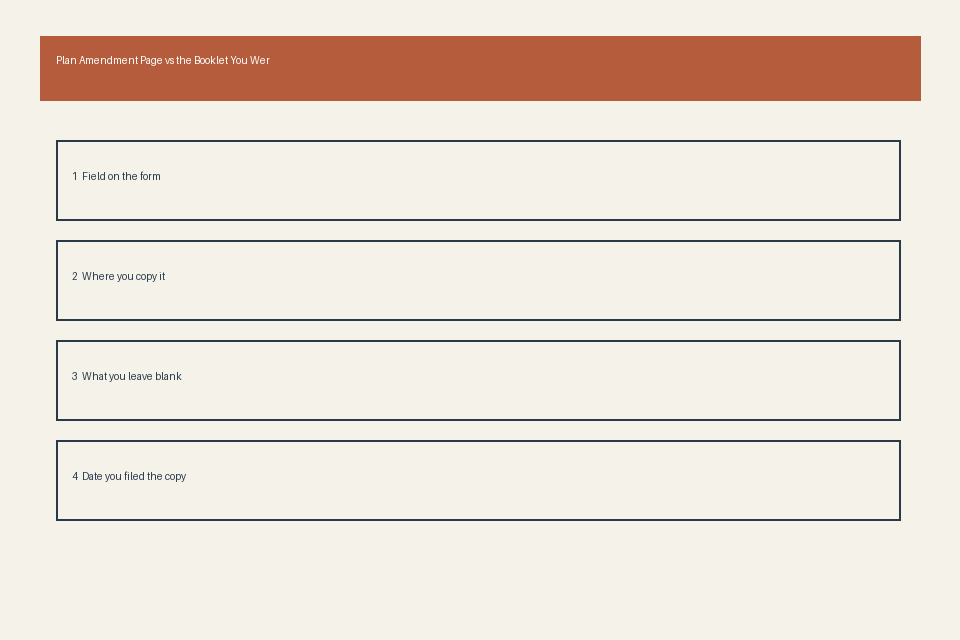
Once you confirm an amendment is valid and matches your agreed-upon coverage changes, you must update your printed policy booklet to track the revision for future reference, following standardized procedures to avoid obscuring original policy terms. First, never cross out, cover, or erase any original text in the policy booklet, as you may need to reference the original terms for claims that occurred before the amendment’s effective date. Instead, add a clear, legible note in the blank margin next to the relevant coverage column that includes three required pieces of information: 1) The amendment page’s official effective date, 2) The unique amendment form ID listed at the top of the amendment, 3) A 1-line summary of the coverage change, for example: “Rental car limit increased from $30/day to $50/day, Amendment ID TX-24-00179, Effective 4/1/2024”. If you use a digital copy of your policy booklet, use the built-in comment feature to add the same tracking information, and save a backup copy of the annotated booklet to both your encrypted cloud storage and a physical USB drive stored with your physical claim file folder. Avoid using removable sticky notes to track changes, as these can fall off or be lost over time; if you use temporary flags for initial tracking, replace them with permanent ink annotations within 7 business days of receiving the confirmed amendment.
Matching policy schedule update verification processes
Every valid, filed amendment you receive must be reflected on your official policy schedule, the one-page summary of your active coverage included with your monthly or quarterly auto insurance billing statements. Follow these verification processes to ensure alignment across all your policy documents: 1) Within 7 business days of receiving a confirmed amendment, pull your most recent policy schedule and confirm that every coverage change listed on the amendment is present and accurate on the schedule. 2) If a change is missing or listed incorrectly on the schedule, submit a scanned copy of the fully executed amendment to your insurer’s billing department and request an updated, corrected policy schedule within 10 business days. 3) Once you receive the updated policy schedule, attach a printed copy of it to the corresponding amendment page and the annotated booklet page in your claim file, so all related documents are stored together. 4) Conduct a full verification of all active amendments against your current policy schedule once every 6 months, or immediately after you file a new auto insurance claim, to ensure no unaddressed mismatches are present that could delay claim processing or result in a denied claim. You may request a free digital or printed copy of your current policy schedule at any time via your insurer’s online customer portal or by contacting your licensed agent.
Pull your auto insurance booklet and all active amendment pages from your claim file today, and complete the first round of signature alignment and coverage column discrepancy checks to resolve any mismatches before you need to file a claim.