
This field map clarifies distinctions between lienholder and additional interest entries across standard vehicle title packet documents. It aligns entries across registration forms, original title documents, verification letters, policy schedules, and submission cover notes to avoid processing delays or incorrect lien priority status. All guidance is structured for use with your physical or digital title packet folder, and no guidance on this page overrides official state DMV or insurer requirements. You may reference Clause Shelf’s standardized field templates for supplementary pre-filled entry examples if needed, but always confirm entries with your lien issuer or local motor vehicle office before submission.
Title registration form lienholder and additional interest entry field locations
Nearly all U.S. state DMV vehicle registration forms reserve clearly marked fields for lienholder entries, typically located on page 2 or 3 of the standard form, separate from vehicle owner and vehicle detail sections. Lienholder fields require the full legal name of the lending institution, their federal employer identification number (FEIN), official DMV-registered mailing address, and 8-12 digit auto loan account number. Additional interest fields are almost always placed in a supplementary section labeled “other interested parties” or “special notifications” rather than the main lien entry block, and are limited to parties that require notification of title changes but do not hold a security interest in the vehicle. Most state registration forms explicitly separate these fields to prevent misclassification, but if you are using a generic third-party registration form, confirm with your DMV which section is reserved for each party type. Never hand-write entries in unmarked sections of the form, as these will be ignored during processing. Illustrative example: California REG 343 forms place lienholder fields in Section G, while additional interested party entries are limited to the optional Section O annotation box, with a maximum of two entries per form.

Vehicle title document lienholder notation box vs additional interest annotation section
Original paper vehicle titles feature a pre-printed lienholder notation box on the front lower third of the document, reserved exclusively for parties holding a formal security interest via a loan, lease, or other financing agreement. Entries in this box grant the lienholder legal right to repossess the vehicle if the loan is in default, and to receive full payoff proceeds in the event of a total loss. Additional interest entries are not permitted in this dedicated lien box, and must be entered on the back of the title in the “remarks” or “special annotations” section, with a formal DMV endorsement stamp to be considered legally valid. Additional interest parties do not hold repossession rights, and are only entitled to receive formal notifications of title transfers, insurance lapses, total loss events, or registration suspensions. If you are submitting a digital title request, the additional interest annotation will be stored in the DMV’s digital title record, and will not appear on the printed front of the title unless explicitly requested. Lienholder entries, by contrast, will always appear on the front of both digital and printed title documents until the lien is formally released via a signed lien release letter. Illustrative example: Texas Certificate of Title forms reserve 2 dedicated lienholder slots on the front, with all additional interest listings printed in the back remarks section, accompanied by a 6-digit DMV processing code for verification.
Lien verification letter required fields for valid additional interest party listing
All title packets requesting an additional interest listing must include a signed lien verification letter from the primary lienholder confirming they consent to the additional party being listed on the title, as additional interest listings do not impact lien priority. The letter must include all of the following mandatory fields to be accepted by state DMVs: 1) Full legal name and FEIN of the primary lienholder, 2) Full legal name and official contact information of the proposed additional interest party, 3) An explicit, unambiguous statement that the additional interest does not hold a security interest in the vehicle and is only being listed for notification purposes, 4) The full 8-12 digit loan account number matching the lien entry on the title and registration form, 5) A handwritten or verifiable digital signature of an authorized lienholder representative, 6) A date of issuance that falls within 30 days of the title packet submission date. If the additional interest is an insurance company or fleet management firm, you may also need to include a copy of their request letter confirming they want to be listed on the title, in addition to the primary lienholder’s verification letter. All letters must be printed on official company letterhead to be considered valid; digital screenshots or unsigned email requests are not accepted by most DMV offices.
Policy matching schedule cross-reference column for matching lienholder to policy information
This cross-reference field map standardizes entries across all title packet documents to reduce processing errors and rejection rates. Keep a printed copy of this schedule in the front of your title packet for quick reference during submission.
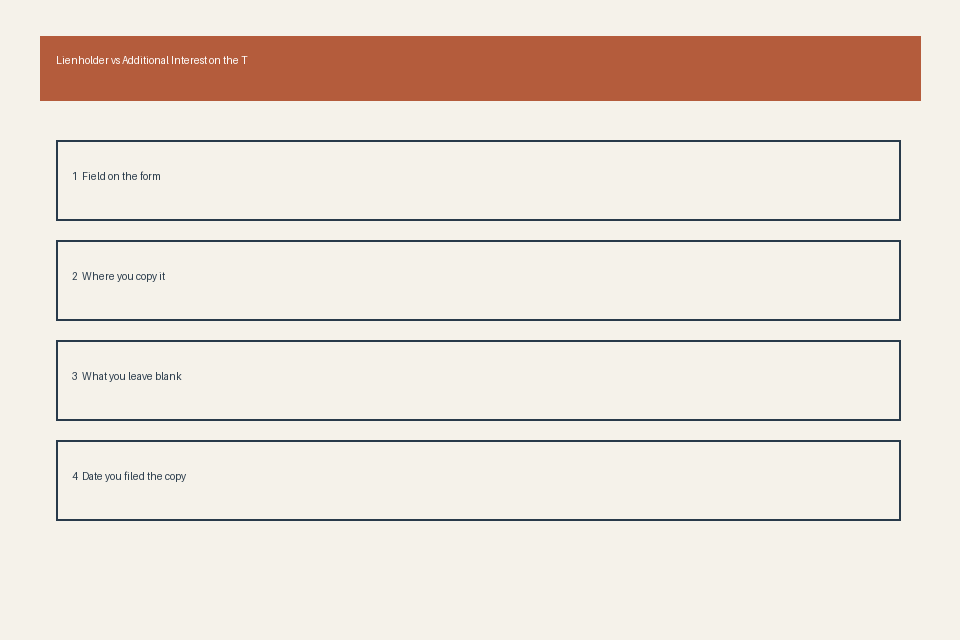
| Document Field Name | Lienholder Entry Requirements | Additional Interest Entry Requirements | Cross-Reference ID Match Location |
|---|---|---|---|
| DMV Registration Form Account Number Field | 10-digit auto loan account number issued by the primary lienholder | 8-digit policy, membership, or permit ID for the additional interested party | Matches line 4 of the auto insurance declarations page or lien verification letter |
| Title Document Legal Name Field | Full legal name of the lending institution as listed on the signed loan agreement | Full legal name of the interested party (e.g. parent co-signer, fleet management company, university parking department) | Matches Section 2 of the signed lien verification letter |
| Submission Packet Mailing Address Field | Lienholder’s official DMV-registered notice address for lien-related correspondence | Additional interest’s designated notification address for title, insurance, or registration updates | Matches line 7 of the primary lienholder’s public business registration filing or the additional interest’s formal request letter |
| Insurance Policy Notification Flag Field | “Mandatory loss payee” designation with first priority for loss disbursements | “Notify of changes only” designation with no disbursement rights | Matches the auto policy’s special instructions section |
| Total Loss Disbursement Routing Field | Lienholder’s loan servicing routing and account number for outstanding payoff funds | No routing number required, only written notification of total disbursement amount and payoff balance | Matches line 12 of the most recent loan payoff statement |
When completing the cross-reference schedule, make sure all entries match exactly across all documents, including spelling of legal names, full account numbers, and mailing addresses. Even a small discrepancy, such as abbreviating “Street” to “St” on one form and spelling it out on another, can trigger a rejection and add 2-3 weeks to processing time. If you are submitting the packet via a third-party title service, provide them with a completed copy of the cross-reference schedule to ensure they do not mix up entries during submission.
Submission cover note mandatory fields to flag joint lienholder and additional interest status
The submission cover note is the first document processed by DMV staff, and it must explicitly flag that your packet includes both a lienholder and additional interest listing to prevent misclassification of the additional interest as a junior lienholder. The cover note must include all of the following mandatory fields: 1) A bold, all-caps header that reads “PACKET INCLUDES BOTH LIENHOLDER AND ADDITIONAL INTEREST ENTRIES” at the top of the page, 2) A line item count of all supporting documents included in the packet, 3) A signed and dated statement from the registered vehicle owner confirming that the additional interest listing is requested voluntarily and does not reflect a security interest in the vehicle, 4) A working contact phone number and email address for the vehicle owner for follow-up questions, 5) The tracking number for the pre-printed self-addressed stamped envelope included if you are requesting a mailed copy of the updated title. If you are submitting your packet online, you can include the cover note as a separate file labeled “Cover Note – Joint Lien and Additional Interest” to ensure it is reviewed first by processing staff. Do not include any unrelated documents, such as insurance cards or registration renewal receipts, in the title packet unless explicitly requested by the DMV, as these can slow down processing. Illustrative example: A cover note for a vehicle with a credit union lienholder and a local college parking department additional interest would include the credit union’s loan account number and the college’s parking permit ID in the special comments section of the note for faster processing.
Your next action: Pull your current vehicle title and registration copies, cross-reference each listed party against the field map above, and note any misclassified additional interest or lienholder entries to correct at your next DMV visit.