
This primary-plan identification table streamlines EOB coordination of benefits reviews for auto insurance claim file administrators. It eliminates guesswork when sorting overlapping coverage from group health plans, personal injury protection (PIP) auto policies, and supplementary accident policies tied to a single injury claim. All guidance on this page is for file organization purposes only; coverage determinations are made exclusively by your plan administrator or licensed insurance carrier. You can reference Clause Shelf’s other process documents for standard folder sorting workflows for related claims paperwork.
Primary Plan Designation Box
This physical or digital folder section is reserved exclusively for written, official documentation that establishes primary plan status per binding plan terms and applicable state or federal rules. Do not store handwritten notes, verbal call summaries, or unconfirmed carrier statements in this box; only signed plan documents, formal COB determination letters, state insurance regulatory bulletins, and policy enrollment verifications belong here. Label the outside of the box with the unique claim ID number, policyholder full legal name, date of the incident triggering the claim, and a list of all plans associated with the claim to prevent misfiling with unrelated claims. If you are missing a plan’s official COB provision, submit a written request to the plan’s administrator directly, and file a copy of your request and any delivery confirmation in this box while you wait for a response. All determinations of primary plan status must be supported by at least one document stored in this box before you process any further claim payments or adjustments.

EOB Coverage Priority Schedule
This schedule is designed to be used as a sorting tool as you receive Explanation of Benefits (EOB) forms from all involved carriers. As you process each incoming EOB, mark the corresponding flag code from the table in the upper right corner of the form, then file it in the appropriate section of your claim folder. If you encounter a coverage scenario that is not listed on the standard schedule, add a custom row to your personal copy of the schedule, including the specific scenario, the rationale for primary plan designation sourced directly from relevant plan documents or regulatory guidance, a custom flag code for tracking, and a list of supporting documents you will file to validate the designation. Never assign primary plan status based solely on the schedule; always cross-check the rationale against the documentation stored in your Primary Plan Designation Box to confirm alignment with binding plan terms.
| Common Coverage Scenario | Primary Plan Rationale | EOB Code to Flag | Supporting Documentation to File |
|---|---|---|---|
| Policyholder is injured in an at-fault accident in their own vehicle, has active personal auto PIP and group health | State auto insurance rules mandate PIP as first-pay for accident-related medical costs in no-fault states | COB-P1-AUTO | State insurance department COB bulletin, auto policy declarations page |
| Dependent child covered by both parents’ group health plans, parents are married, no court order for coverage | Birthday rule applies: plan of the parent whose birthday falls earlier in the calendar year is primary | COB-P1-BDAY | Both parents’ birth dates on file, plan enrollment confirmations |
| Policyholder has employer-sponsored group health and a supplementary individual accident policy purchased on the private market | Group plan sponsored by the policyholder’s active employer is designated primary per standard COB hierarchy for non-auto, non-workplace claims | COB-P1-GRP | Employer benefits handbook COB section, supplementary policy coverage terms |
| Policyholder is injured in a workplace accident, has workers’ compensation and active group health | Workers’ compensation is exclusive primary pay for medically necessary care tied to a documented work-related injury | COB-P1-WC | Workers’ comp claim approval letter, incident report from employer |
| Policyholder is covered under COBRA continuation and a new employer’s group health plan | Active employer group plan is primary, COBRA is secondary unless the COBRA plan document explicitly states otherwise | COB-P1-ACTIVE | New employer enrollment verification, COBRA plan COB provision |
Benefit Coordination Verification Form
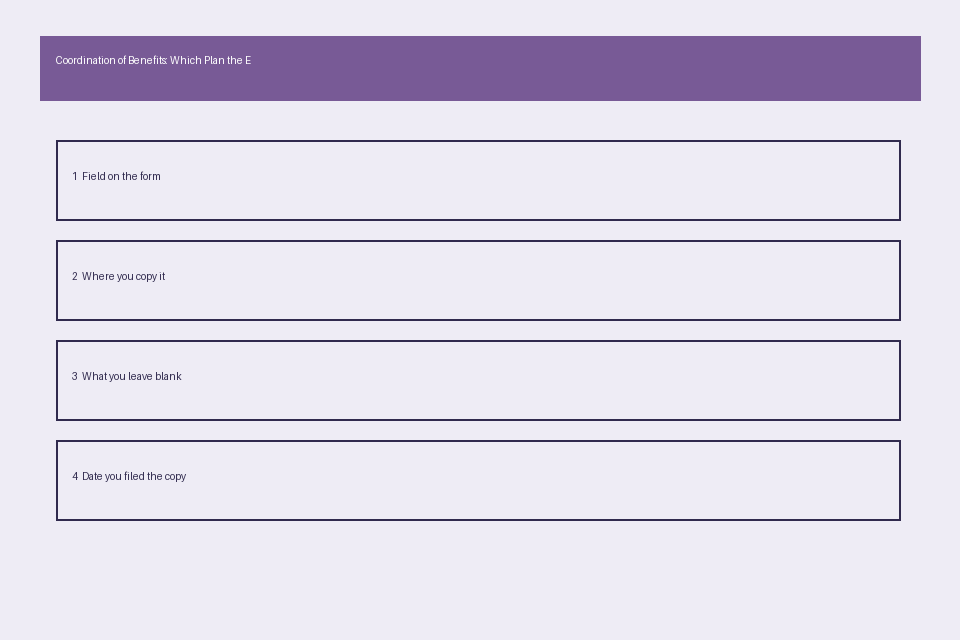
This standardized form is used to formalize primary and secondary plan designations with all involved carriers, eliminating disputes later in the claims process. While exact form requirements vary by state and carrier, every completed form should include the policyholder’s full legal name, date of birth, and contact information; full identifying details for any dependents included in the claim; the date, location, and type of incident triggering the claim; a complete list of all plans involved, including policy numbers, group numbers, and carrier contact information; a blank section for each carrier to sign, date, and confirm their status as primary, secondary, or tertiary payer; and a clear deadline of 15 business days from the date of submission for carriers to return the completed form. File a signed copy of every submitted form in this section, along with certified mail receipts, email read receipts, or other delivery confirmation to prove you provided all required information to carriers in a timely manner. If a carrier fails to return the form by the stated deadline, document the missed deadline in your claim log, send a written follow-up request, and copy your licensed insurance broker or plan administrator on the request to escalate appropriately. This page does not constitute official legal or plan advice; always use the COB verification form approved by your state insurance department or plan administrator when submitting formal requests to carriers.
Dependent Coverage Mapping Column
This dedicated column in your digital claim tracker or physical folder log is used to centralize all coverage details for dependents included on the claim, eliminating gaps in visibility into overlapping coverage. For each dependent listed on the claim, the column should include their full legal name, date of birth, relationship to the primary policyholder, a complete list of all plans that provide coverage for the dependent, the effective and termination dates for each plan, and any applicable court orders, divorce decrees, custody agreements, or qualified medical child support orders (QMCSOs) that specify coverage priority. For adult dependents covered under both a parent’s group plan and their own employer-sponsored plan, note that the dependent’s own active employer plan is almost always designated primary, unless the dependent qualifies as a permanently disabled lifelong dependent under the parent’s plan terms. Illustrative example: If a 12-year-old dependent is covered by a mother’s plan with a birthday in March and a father’s plan with a birthday in July, you would note in the mapping column that the mother’s plan is primary per the standard birthday rule, and attach a copy of both parents’ government-issued photo IDs to verify their birth dates for carrier review. Update this column immediately any time you receive formal notification of a change to a dependent’s coverage status, such as a loss of eligibility, new enrollment, or updated court order, to avoid processing errors.
Secondary Plan Cross-Check Folder
This dedicated folder section is reserved for tracking secondary plan processing once you have confirmed primary plan status and received the primary plan’s EOB. Only file secondary EOBs in this folder once you have matched them to the corresponding primary EOB, and confirmed the primary plan has fully processed their portion of the claim, with a clear breakdown of allowed amounts, primary plan payments, contractual adjustments, and remaining patient responsibility. Keep a printed log sheet in the front of this folder that lists every line item of the claim, the date the primary EOB was received, the date the secondary claim was submitted to the secondary carrier, the date the secondary EOB was received, the amount paid by the secondary plan, and any remaining balance after both plans have issued payments. If a secondary carrier incorrectly processes a claim as primary, you can submit an appeal that includes a copy of the primary plan’s formal COB determination letter, the primary EOB, and the signed COB verification form returned by both carriers; file all appeal documentation, including submission confirmations and appeal decision letters, in this section for your records. You can reference Clause Shelf’s standard EOB appeal tracking template for help organizing these materials to reduce processing delays for appealed claims. This page cannot bind coverage or make claim determinations; all coverage questions should be directed to your plan administrator or a licensed insurance professional.
Before processing your next coordination of benefits claim, print a copy of the primary-plan identification table above and keep it in the front of your auto insurance claim file for quick reference when sorting incoming EOBs.