
This reference helps you compare documented and undocumented deductible entries on your auto insurance claim paperwork. It breaks down how to distinguish formally recorded deductible amounts from unlisted, unconfirmed entries that may appear during the claims processing cycle, so you can flag errors before you pay out of pocket or accept a reduced claim payout. You can use this guide alongside your physical auto insurance claim folder to cross-reference every entry related to your out-of-pocket cost obligation. This educational resource from Clause Shelf does not bind coverage or adjust claim terms, so always direct specific coverage questions to your licensed insurance provider or broker.
Claim form box showing your formally documented listed deductible amount
When you submit an initial auto insurance claim form, either digital or physical, there is a standard pre-printed field reserved for your policy’s listed deductible amount for the applicable coverage type (collision, comprehensive, uninsured motorist property damage, etc.). If you fill out the form yourself, you will enter this amount directly from your policy records; if your insurer pre-fills the field for you, you are required to confirm its accuracy before signing and submitting the form. Any entry in this box that is dated and signed by both you and a representative of your insurer counts as a formally documented deductible amount, and you should retain a signed copy of this completed form in your claim folder for all future reference. If you need to amend the amount in this box after submission, you must request a formal written amendment to the claim form, signed by both parties, to make the change enforceable. Verbal adjustments to this field over the phone or in a casual text exchange do not count as formal documentation, even if they come from a member of your insurer’s claims team.

Policy declaration schedule listing your pre-approved stated deductible terms
Your policy declaration schedule, issued to you at the start of each policy term or after any formal policy change, is the primary authoritative document for all your pre-agreed coverage terms, including your per-claim deductible amounts for each applicable coverage line. This document is issued in writing (either physical or certified digital) by your insurer, and includes an effective date, policy number, and signature from an authorized insurer representative to confirm its validity. You should store a hard copy of your most recent declaration schedule, plus any signed addendums that adjust your coverage terms, in the front of your auto insurance claim folder for immediate cross-reference during all claims processing steps. Illustrative example: If your declaration schedule lists a $500 collision deductible, a verbal note from a customer service representative saying you qualify for a $0 deductible for a specific claim is not enforceable unless it is added as a signed, dated addendum to your official declaration schedule. Any deductible amount listed on your declaration schedule takes precedence over verbal statements or unconfirmed digital notes unless a formal, signed amendment modifies the terms.
Adjuster work note referencing unlisted post-accident deductible adjustments
Claims adjusters frequently add internal work notes to your digital claim file as they process your request, and these notes may include references to adjusting your deductible amount for reasons ranging from suspected partial fault in the accident, missing proof of coverage, or a misclassification of your claim type. These internal notes are not automatically shared with policyholders, and they do not count as formal, documented deductible adjustments unless they are shared with you in writing and you provide signed consent to the change. You have the right to request a full, unredacted copy of all adjuster work notes related to your claim at any point during processing, and you should add any notes you receive to your physical claim folder for cross-referencing. If you identify a reference to a deductible amount that differs from what is listed on your declaration page or signed claim form in these notes, you can flag the discrepancy immediately and request written justification for the proposed change before proceeding with claim resolution. Adjusters cannot enforce a changed deductible amount without providing formal written justification and securing your signed agreement to the new terms.
Benefit statement column marking unconfirmed unlisted deductible line items
When your insurer sends you a formal claim benefit statement outlining the approved payout for your damages, there will be a dedicated column for all out-of-pocket deductions applied to your payout, including your required deductible. Carriers sometimes add unconfirmed, unlisted deductible amounts to this column due to common administrative errors like cross-referencing the wrong policy number, applying deductible terms for an outdated policy period, or misclassifying your coverage type. These unconfirmed entries are not enforceable until you verify their accuracy against your stored documentation and agree to the amount in writing. You should cross-check every line item in this deduction column against your signed claim form, declaration schedule, and any formal amendment documents before accepting the proposed payout or paying any requested deductible amount to your repair shop or insurer. Illustrative example: If your benefit statement lists a $1,000 collision deductible but your signed claim form and current declaration page both list a $500 collision deductible, this is an unconfirmed unlisted entry that requires formal correction by your insurer before you finalize your claim. You can submit a copy of your stored documentation to your claims representative to request a revised benefit statement with the correct deductible amount.
Physical claim folder storing proof for disputed deductible amount discrepancies
Organizing all deductible-related documentation in a dedicated physical auto insurance claim folder is the most reliable way to resolve any deductible discrepancy quickly and efficiently. You should order all documents in the folder by date, with the most recent records added to the front, and make a full copy of the entire folder before submitting any original or official copies to your insurer, so you retain a complete set of records for your personal files. Your folder should include your signed initial claim form, current policy declaration page plus all applicable addendums, full copies of all adjuster work notes you have requested, every version of the benefit statement you receive from your insurer, all written correspondence with your insurer related to deductible terms, and proof of any pre-approved deductible waivers you qualified for during your policy term. Having all these records stored in one accessible location reduces the time it takes to prove a discrepancy and ensures you do not pay an incorrect out-of-pocket amount for your claim.
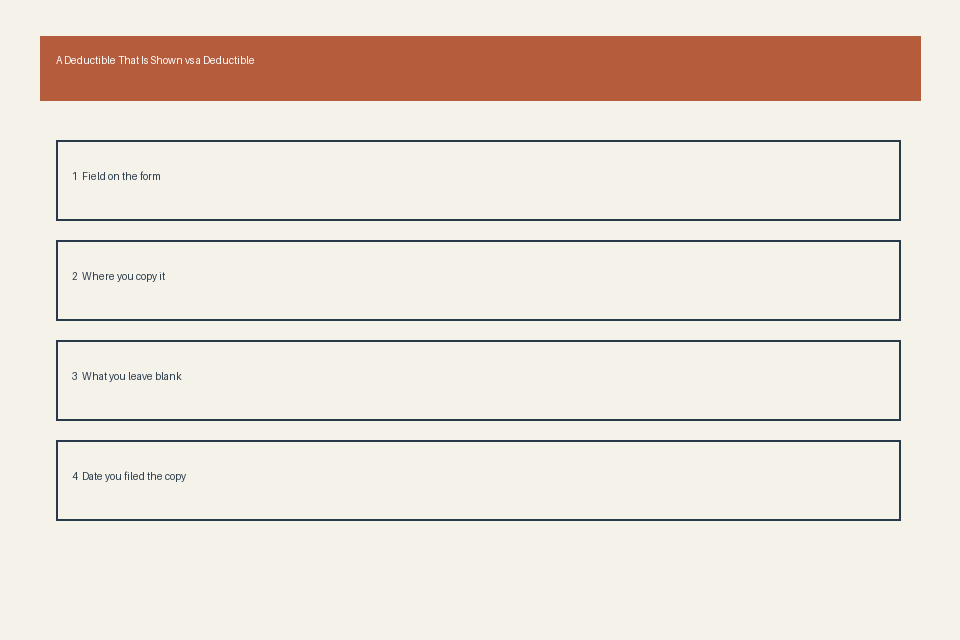
Fillable Deductible-Shown Reference Card (Print and store in your claim folder)
| Field Name | Document Source | Confirmed Shown Amount (Fill In) | Date Verified | Notes for Discrepancies |
|---|---|---|---|---|
| Collision claim deductible | Policy declaration schedule | Cross-check against initial claim form entry before signing submission | ||
| Comprehensive claim deductible | Signed initial claim submission | Note any applicable safe-driving or loyalty waivers attached to your policy | ||
| Uninsured motorist property damage deductible | Carrier-issued first benefit statement | Flag immediately if amount differs from declaration page by any margin | ||
| Adjuster-proposed adjusted deductible | Formal adjuster work note request response | Only valid if you sign a written policy amendment approving the change | ||
| Final agreed deductible | Signed claim resolution document | Retain a copy of this signed document in your folder for 7 years post-claim closure |
Before your next scheduled claim status check, pull your most recent policy declaration page and fill out the first two rows of the deductible-shown reference card to have confirmed, documented amounts on hand to address any questions about your deductible obligation.