
Printed operations-type identification cards list specific coverage terms tied to commercial insurance policy endorsements that separate work performed in real time (ongoing operations) from work that has been finalized, inspected, and handed off to a client (completed operations). Misclassification of these two operation types on an endorsement is a top cause of delayed commercial general liability claim processing, as coverage limits, exclusions, and reporting windows differ substantially between the two categories. Tracking these differences across your physical and digital policy folders eliminates unnecessary back-and-forth with your policy issuer during a claim filing, and ensures you only submit relevant supporting documentation for each operation type. Clause Shelf provides standard organizational templates to align your paperwork with common endorsement formatting requirements, though you should always confirm all details directly with your licensed policy provider, as this page does not bind coverage or make claim eligibility determinations.
Coverage tier box that flags completed vs ongoing operation eligibility periods
This section of the endorsement, typically located in the upper right quadrant of the first page of the addendum, includes clearly marked checkboxes and eligibility windows that outline which operation types are covered under the policy terms, and any restrictions that apply to each. Ongoing operations coverage applies exclusively to work that is actively in progress, including pre-job setup, daily on-site tasks, interim maintenance, and post-job teardown that occurs while the project is still under your team’s supervision and has not been formally accepted by the client. Completed operations coverage applies only after all work has been finished, all required inspections have been passed, and the client has signed a formal acceptance of the project, covering claims related to defective work, third-party property damage, or bodily injury that arises after the client has taken full possession of the space or deliverable. Many endorsements include a sunset provision for completed operations coverage, which caps the eligibility window for these claims at a set number of years post-project handover, and this term is clearly listed in the coverage tier box for easy reference. You should cross-reference the details in this box with the information printed on your operations-type identification card immediately upon receiving a new endorsement, and request a corrected document within 10 business days if any mismatches are found, as inconsistent information can lead to automatic claim denial.

Policy endorsement form cross-referenced on all official operations-type identification cards
Every valid operations-type identification card includes a unique alphanumeric endorsement form number printed in the lower left corner, which ties directly to the specific endorsement addendum attached to your base commercial general liability policy. This cross-reference number ensures that all parties accessing the ID card, including site safety managers, client representatives, and claim adjusters, can pull the exact policy terms that apply to your work with no ambiguity. The cross-referenced endorsement form will list all applicable exclusions for each operation type: for example, ongoing operations coverage may exclude damage to your own team’s tools and work materials, while completed operations coverage may exclude claims that arise from unauthorized modifications the client made to your work after handover. You should store a full printed copy of the cross-referenced endorsement form directly behind your operations-type identification card in your policy folder, so it is immediately accessible if you need to verify coverage during a site audit, client onboarding check, or claim intake process. If your endorsement is amended mid-policy term to adjust coverage limits, eligibility windows, or excluded work types, your issuer will send a revised operations-type identification card with a new cross-reference number, and you should discard all old versions of the card to avoid submitting incorrect documentation during a claim.
Physical document folder for storing issued operations-type identification cards and related paperwork
Your dedicated operations coverage folder should be a labeled 3-ring binder with tabbed dividers for each document category, and you should maintain a fully scanned digital copy of the entire folder in a password-protected cloud drive accessible to your operations manager and designated policy contact. No extraneous documents, including payroll records, client marketing materials, or non-related policy addenda, should be stored in this folder, as sorting through unrelated paperwork can slow down claim processing or lead to accidental submission of irrelevant information during an audit. The following table outlines the required contents of the folder, and which documents are required for each operation type during a claim filing:
| Folder Section Number | Document Type | Required for Ongoing Operation Claims | Required for Completed Operation Claims | Retention Period |
|---|---|---|---|---|
| 1 | Active operations-type identification card | Yes | Yes | Entire policy term + 7 years post-policy expiration |
| 2 | Cross-referenced policy endorsement form addendum | Yes | Yes | Entire policy term + 10 years post-policy expiration |
| 3 | Daily work logs, on-site safety checklists, and interim inspection sign-offs | Yes | No | Until formal project handover and client acceptance is finalized |
| 4 | Client project acceptance forms, final inspection reports, and post-handover communication records | No | Yes | 10 years post-final project handover date |
| 5 | Claim submission confirmation receipts and adjuster correspondence for any filed incidents | Yes | Yes | 7 years post-final claim resolution date |
All documents in the folder should be printed in black and white on standard 8.5×11 inch paper, with no handwritten edits except for those explicitly approved and initialed by an authorized representative of your policy issuer.
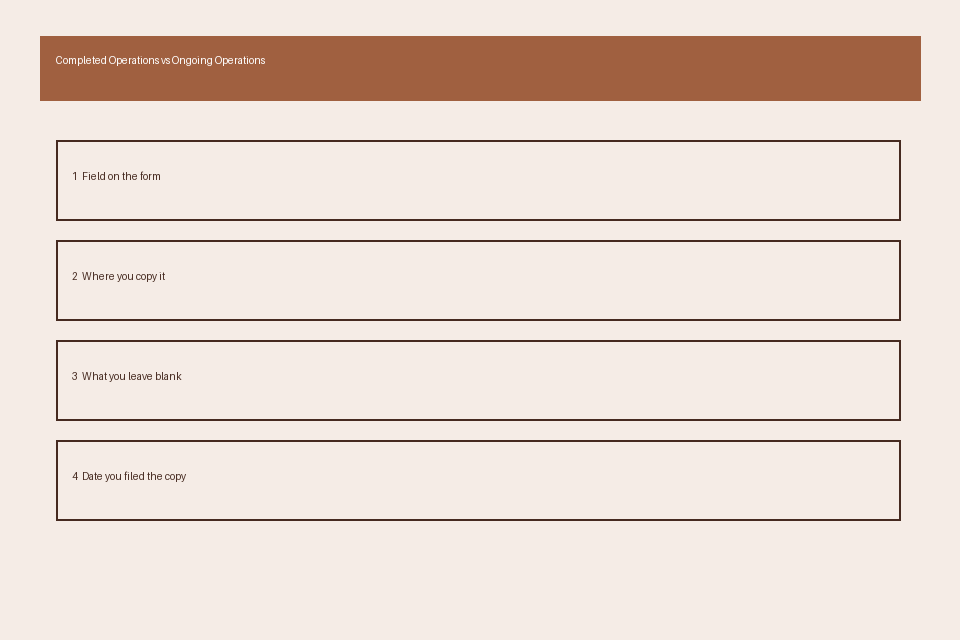
Validity date schedule marking transition points between ongoing and completed operation terms
Every policy endorsement includes a clearly marked validity date schedule that lists the exact start and end dates for each operation type’s coverage, as well as specific transition dates for individual projects if you hold a per-project commercial liability policy. For ongoing operations, the validity start date aligns with the first day your team is scheduled to be on site performing work, and the end date aligns with the scheduled final day of on-site work before handover. For completed operations, the validity start date is the first day after formal client acceptance, and the end date aligns with the sunset provision term listed in the coverage tier box. Illustrative example: a commercial electrical renovation project may have an ongoing operation coverage window from March 1, 2024 to May 22, 2024, and a completed operation coverage window from May 23, 2024 to May 23, 2027. You should mark these transition dates in the designated notes section on the reverse of your operations-type identification card using a permanent, non-erasable pen, and also add them to your company’s shared project management calendar, so all team members know which coverage type applies if an incident occurs. If a project runs over its scheduled timeline, you must request an endorsement amendment and revised operations-type identification card at least 3 business days before the original ongoing operation coverage end date, to avoid a gap in coverage that could leave your company liable for uncovered claims.
Issuer validation note printed on the reverse of every official operations-type identification card
The back of every valid, official operations-type identification card includes a pre-printed issuer validation note that contains the policy issuer’s full legal name, state insurance license number, direct claims department phone number, and a signature line for an authorized issuer representative. If your operations-type identification card does not include this full validation note, it is not considered an official document, and will not be accepted for site access audits, client coverage verification, or commercial claim filing. You should verify the details of the validation note within 3 business days of receiving a new or revised ID card, by calling the issuer’s official customer service line listed on your base policy documents (not a number listed on an unsolicited email or text message) to confirm the representative’s signature and license number match their official internal records. Many state regulatory bodies require a physical, signed copy of the ID card for on-site verification, so you should keep a physical copy of the card in your on-site work folder as well as your main policy binder, and only rely on digital copies if your issuer has explicitly confirmed in writing that digital versions are accepted for all official use cases.
Pull your most recent operations-type identification card and cross-reference the listed endorsement form number with your physical policy folder to confirm the coverage tier box and validity date schedule match across all documents.