
This notice-day comparison card standardizes cross-reference between auto insurance certificates and active policy cancellation terms for commercial fleet operators, personal auto policy holders, and employee benefit plan participants tracking compliance with state rules, lender requirements, lease terms, and employer coverage mandates. It is designed for storage in your dedicated auto insurance claim file or employee benefits statement folder to flag gaps that could lead to unexpected lapses in coverage, penalties for non-compliance with third-party coverage requirements, or missed opportunities to appeal a cancellation decision before your coverage ends. Clause Shelf provides this reference as an educational tool only, not a substitute for formal review by a licensed insurance professional, your policy issuer, HR benefits desk, or registered insurance broker. This page does not bind coverage, modify existing policy terms, or decide eligibility for claims.
Certificate printed column mapping stated minimum cancellation notice windows
Most standard auto insurance certificates (including widely used ACORD 25 and state-specific commercial fleet certificate forms) include a dedicated, clearly labeled printed column on the front page of the document listing the minimum number of days the insurer will provide advance notice of cancellation to the named certificate holder. Certificate holders may include auto lenders, vehicle leasing companies, employer fleet management teams, or client organizations that require proof of coverage for contracted work. This column is intentionally placed in the top third of the certificate, separate from fine print terms, to allow for quick verification of notice terms without reviewing full policy documents. If this column is left blank, filled with a non-numeric entry, or lists a term shorter than the minimum required by your contract with the certificate holder, you should flag the document for immediate follow up with the party that issued the certificate. Note that the number listed in this column is the commitment the insurer has made to the third-party certificate holder, not the full set of cancellation notice terms that apply to you as the named insured under your underlying policy.

Policy text box listing formal non-renewal notice advance day mandates
The full, binding auto insurance policy document (not the summary certificate) includes a dedicated, bordered text box in the General Provisions section, typically under the “Cancellation, Non-Renewal, and Policy Termination” header, that lists all formal notice requirements for both the insurer and the named insured. These requirements are separated by the reason for cancellation or non-renewal, as different thresholds apply to different scenarios. Common categories listed in this text box include cancellation for non-payment of premium, cancellation for material misrepresentation on your policy application, cancellation for failure to comply with policy terms (such as allowing an unlicensed driver to operate the covered vehicle), voluntary cancellation requested by the named insured, and non-renewal of the policy at the end of its standard 6 or 12 month term. Illustrative example: A standard personal auto policy may require 10 days advance notice to the named insured for cancellation due to non-payment, 30 days advance notice for cancellation for all other insurer-initiated reasons, 20 days advance notice if you choose to cancel your policy voluntarily, and 45 days advance notice for non-renewal at the end of the policy term. These terms are legally binding between you and your insurer, and will supersede any conflicting terms listed on the certificate of insurance unless the insurer has formally added an endorsement to your policy extending notice periods for a specific certificate holder.
Side margin note flagging discrepancies between certificate and policy notice periods
When you cross-reference the cancellation notice terms on your certificate against the terms in your full policy, you should document any discrepancies with a dated, handwritten note in the left side margin of both the certificate and the relevant policy page in your folder. Your note should include the exact numerical discrepancy you identified, the reason for the discrepancy (if immediately apparent), the date you identified the gap, and the contact information for the party you will follow up with to resolve the issue (your broker, policy issuer, HR benefits desk, or fleet manager). Common discrepancies you may flag include a certificate listing a 30 day cancellation notice window when the policy only requires 10 days notice for non-payment, a certificate leaving the notice period column blank when the policy mandates a 20 day minimum for all cancellation reasons, or a certificate listing a notice window that is shorter than the minimum required by your state’s insurance regulations. Unaddressed discrepancies can lead to the third-party certificate holder not receiving sufficient advance notice of cancellation, resulting in penalties for non-compliance with lease or employment terms, forced placement of more expensive lender-placed insurance, or gaps in coverage that leave you financially responsible for damages that would otherwise be covered under your policy. You should attach a copy of this margin note to a dedicated discrepancy tracking sheet in your folder to create a clear paper trail of your follow up efforts.
Annexed reference schedule of state-mandated minimum cancellation notice day thresholds
All U.S. states set legally required minimum cancellation notice periods for auto insurance policies, which act as a floor for the terms that can be included in your policy or listed on your certificate of insurance. Insurers may choose to offer longer notice periods than the state minimum, but they cannot offer shorter periods without violating state insurance regulations. The reference schedule below lists illustrative current minimum thresholds for common U.S. states, for reference only:
| State | Non-Payment Cancellation Minimum Notice Days | All Other Cancellation Reasons Minimum Notice Days | Non-Renewal Minimum Notice Days | Applicable Auto Policy Type |
|---|---|---|---|---|
| California | 10 | 30 | 45 | Personal & Commercial Fleet Auto |
| Texas | 10 | 20 | 30 | Personal Auto |
| New York | 15 | 30 | 45 | Personal & Commercial Auto |
| Florida | 10 | 20 | 30 | Personal Auto; 10/30 for Commercial Fleet |
| Illinois | 10 | 30 | 30 | Personal & Commercial Auto |
You should confirm current, jurisdiction-specific requirements with your state’s department of insurance before relying on these figures, as state regulations are updated periodically and may have carve-outs for specific policy types, such as high-risk auto insurance plans or commercial fleet policies for vehicles with a gross vehicle weight rating over 26,000 pounds. Some states also have separate requirements for notice provided to the named insured versus notice provided to a third-party certificate holder, so you should review both sets of rules when verifying compliance of your certificate and policy terms.
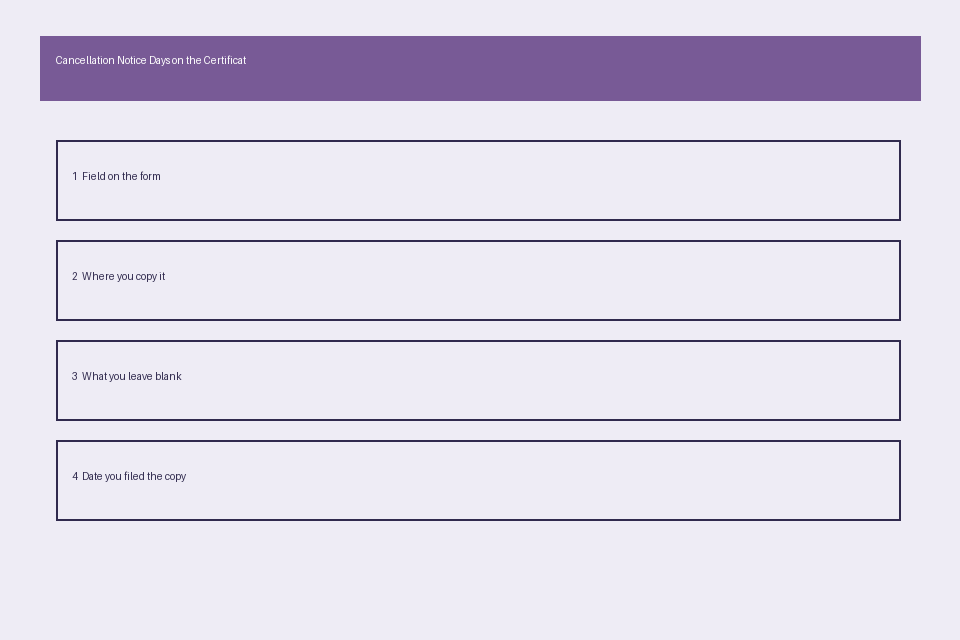
Verification check form for confirming aligned notice day language across all policy documents
You can use this simple, fillable verification check form, stored in your auto insurance file folder, to confirm alignment of notice terms every time you receive a new certificate of insurance or policy renewal document:
- Certificate notice period entry field: Enter the exact number listed in the cancellation notice column of your current certificate, or note if the field is blank or includes a non-numeric entry.
- Policy notice period entry fields: Enter the notice periods listed in your policy’s cancellation text box for each applicable scenario: non-payment cancellation, other insurer-initiated cancellation, voluntary cancellation, and non-renewal.
- State minimum compliance check field: Mark a check box confirming that all notice periods listed on your certificate and policy are equal to or longer than the applicable state-mandated minimums for your jurisdiction and policy type. If any term is shorter than the state minimum, mark a high-priority flag for immediate follow up.
- Discrepancy documentation field: If there is any discrepancy between the certificate notice period, policy notice periods, or state minimums, enter the date you notified your broker, issuer, HR desk, or other relevant party of the gap, and attach a copy of your notification (email, letter, or phone call log) to this form.
- Resolution confirmation field: Once you receive written confirmation from the issuer that the discrepancy has been resolved, or that a revised certificate or policy endorsement has been issued to align the terms, enter the date of the confirmation and attach a copy of the confirmation letter to this form.
You should retain a completed copy of this verification form in your folder for every policy term, as it serves as proof of your due diligence in maintaining compliant coverage if a dispute arises over cancellation notice timelines. This form is for your personal record-keeping only, and does not modify your policy terms or constitute a formal request for changes to your coverage. Printable versions of this verification check form are available for free personal use from Clause Shelf if you do not wish to create your own from scratch.
Before filing your next auto insurance certificate or policy renewal document, complete all fields of the verification check form to identify and resolve any notice period discrepancies within 3 business days of receipt.