Gather relevant auto insurance payment records to address unprocessed premium deductions from your recent payroll runs before reaching out to your HR payroll team or auto insurance carrier. A single missed deduction can lead to a temporary lapse notice if not corrected within your policy’s grace period, so organizing supporting documentation first cuts down on processing delays and avoids back-and-forth requests for verification. You can store all related paperwork in your existing auto insurance claim file or employee benefits folder for easy access during follow-ups, and reference Clause Shelf’s standard document checklists to make sure you don’t omit critical proof of your scheduled deductions. This guidance is for educational purposes only; always verify adjustment requirements with your HR benefits desk, insurance broker, or licensed insurance professional, and this document does not bind coverage, adjust claim outcomes, or override official payroll or carrier policies.
Printed payroll folder entries for monthly auto insurance premium payment postings
Start by pulling physical or digital prints of your payroll records for the three pay periods preceding the missed deduction, the pay period with the confirmed missing deduction, and the first pay period after the error. Each entry should show individual line items for all pre-tax benefits, including the separate line for auto insurance if you have elected payroll deduction as your payment method. Highlight the missing auto insurance line item on the affected pay stub, and add a handwritten note in the margin specifying the date you identified the error for your own paper trail. Even if you primarily store digital payroll records, print physical copies for your folder, as annotated physical documents are often accepted faster by both payroll teams and insurance carriers when verifying errors. You should also include any payroll correction notices issued for the same pay period, as these can support your claim that the missing deduction was the result of a system error rather than a lapsed election on your part.
Signed policy letter confirming scheduled auto insurance payroll deduction amounts
Locate your original auto insurance policy endorsement that explicitly confirms you elected payroll deduction as your preferred payment method, plus the fixed amount that should be deducted each pay period. This document must be signed by an authorized representative of your insurance carrier, not a generic emailed quote or open enrollment summary, to serve as official verification of your agreed deduction schedule. If you do not have a physical copy of this letter, request a certified copy from your insurance broker or carrier’s customer service team, and confirm that the effective date of your payroll deduction election covers the pay period with the missing deduction. You can also attach a copy of your open enrollment election confirmation to this letter to further prove you are eligible for the payroll deduction benefit for the full plan year. This letter will also be critical if you receive a late payment notice from your carrier, as it proves you did not intentionally miss a payment, and the error originated with payroll processing.
Premium adjustment form for correcting undercollected auto insurance premium balances
The premium adjustment form is the official document you will submit to your HR benefits desk to request correction of the missed deduction, and you can usually access a blank copy via your employee self-service portal or in-person HR office. Before submitting the form, use the missed-deduction checklist below to confirm you have all required supporting materials organized to avoid processing delays:
| Checklist Item | Required Location in Your Folder | Completion Status (Check When Done) | Notes Field |
|---|---|---|---|
| Affected pay stub printed with missing auto insurance deduction line item highlighted | Employee benefits folder, auto insurance claim file subfolder for payment records | ☐ | Enter pay period date here: _______ |
| Signed policy endorsement confirming scheduled payroll deduction amount and effective date | Auto insurance policy documents subfolder | ☐ | Enter scheduled deduction amount here: _______ |
| Prior 3 pay stubs showing consistent auto insurance deductions before the missed pay period | Employee payroll records subfolder | ☐ | Note any prior deduction errors here if applicable: _______ |
| Written request for repayment schedule (if requesting split deductions across future pay periods) | Adjustment form supporting documents subfolder | ☐ | Enter number of requested pay periods for repayment here: _______ |
| Proof of active auto insurance coverage for the affected pay period | Auto insurance proof of coverage subfolder | ☐ | Enter policy number here: _______ |
When filling out the adjustment form, fill in all fields even if they are marked as optional to reduce processing time. Illustrative example: If your scheduled monthly auto insurance deduction is $82, and it was missed on your September 15 pay stub, you would enter $82 as the undercollected amount on your adjustment form, plus your policy number, employee ID, and coverage effective date even if only your employee ID is marked as required. You can request a repayment plan that splits the missed deduction across 2 to 3 future pay periods to avoid a significant reduction in your take-home pay for a single cycle, and most payroll teams will approve this request for undercollected amounts under $500, though you should confirm your employer’s specific policies before submitting. Keep a signed copy of the completed form and all supporting documents in both your employee benefits folder and auto insurance payment records folder, and note the submission date for follow-up if you do not receive confirmation within 10 business days.
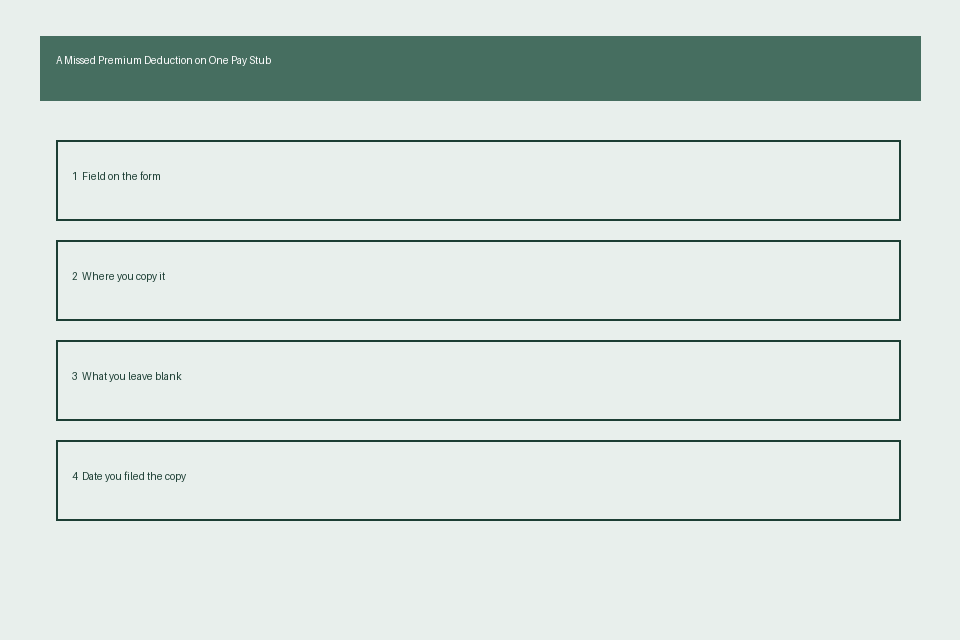
Pay stub year-end column listing all processed auto insurance premium deductions
After your adjustment is submitted and approved, cross-reference the corrected deduction with the year-end column on your pay stub that tracks all pre-tax auto insurance premium deductions for the current tax year. This column is separate from other pre-tax benefits like health insurance or retirement contributions, so confirm you are reviewing the correct line item rather than a combined benefits total. Once the adjustment is processed, verify that the missed amount is added to this year-end total to avoid discrepancies on your end-of-year W-2 form, which could impact your tax filings. If the correction is processed in a different calendar year than the missed deduction, request a corrected W-2 if the adjustment changes your total pre-tax benefit amounts for the original year, and store a copy of the corrected W-2 with your tax records. You can also compare the total year-end auto insurance deduction amount to the total annual premium listed on your policy declarations page to confirm all payments have been accounted for and you have not overpaid for coverage.
Paper confirmation note verifying payroll system updates for missed deduction fixes
Once your adjustment form is approved, request a printed, signed confirmation note from your payroll department that verifies the payroll system has been updated to process the missed amount via your agreed repayment schedule, and that no future auto insurance deduction errors will occur for your account. This note must be signed by a payroll team member with authority to make system changes, not a generic auto-reply email, to be considered official. Include a copy of this confirmation note in both your benefits folder and auto insurance records, and send a separate copy to your insurance carrier to note on your account that the missed payment was due to a payroll error, and the balance will be paid in full within your agreed repayment window. This can prevent late fees or formal lapse notices from being added to your policy record. If you do receive a late fee before the adjustment is processed, you can submit a copy of the confirmation note to your payroll team to request they cover the fee, as the error originated with their system. Check your next two pay stubs to confirm the agreed deduction amounts are processed correctly, and follow up immediately if the adjustment does not appear as scheduled.
Pull your two most recent pay stubs and your auto insurance deduction endorsement within the next 3 business days to confirm the exact amount of the missed deduction before submitting your adjustment request.