All auto repair estimate line cards require clear labeling of any aftermarket parts proposed for collision-damaged passenger vehicle repairs. This labeling requirement applies to all non-OEM (original equipment manufacturer) parts, including recycled, remanufactured, and generic aftermarket components that do not come directly from the vehicle’s original production supply chain. Failing to correctly disclose these parts on your estimate can lead to billing disputes, coverage denials, or unapproved repair work that you may be responsible for paying out of pocket. This process page is designed to help you audit incoming repair estimates for full compliance with standard disclosure rules, and you can cross-reference these requirements with guidance from your adjuster or licensed repair professional if you have questions, per Clause Shelf educational resources.
Disclosure box specifications for aftermarket part designation
All estimates that include one or more aftermarket parts must feature a standardized disclosure box on the first page of the document, per most state department of insurance requirements. The box must be positioned within the top 2 inches of the page, below the repair shop and insurer contact information but above the first line item of repair work, to ensure it is visible before you review any part details. The text inside the box must be no smaller than 10-point bold font, with high contrast against the page background to avoid being overlooked. Required verbiage in the box includes a clear statement that aftermarket parts are not manufactured by or on behalf of the vehicle’s original maker, may differ from OEM parts in fit, finish, corrosion resistance, and durability, and that you retain the right to request OEM parts for the repair if your auto insurance policy allows for OEM part coverage, or if you are willing to pay the difference in cost between aftermarket and OEM parts. Many states also require a signature line in this box for you to acknowledge that you have received and reviewed the aftermarket part disclosure before any repair work begins. If the disclosure box is missing, positioned in a hard-to-find location, or uses unreadable small font, you can decline to approve the estimate until the shop revises the document to meet these specifications.
Line card form fields that mandate part origin entries
Every line item on the repair estimate that references a replacement part must include entries for standardized origin fields, as outlined in the parts-disclosure line card table below. No blank entries are permitted for these fields when applicable, and abbreviations are only allowed if they are explicitly listed as acceptable in the table. You can use this table to audit each part line on your estimate for full disclosure:
| Field ID | Field Label | Mandatory Entry Requirement | Acceptable Entry Values |
|---|---|---|---|
| PD-001 | Part Origin Code | Required for all part lines with a unit cost over $25 | OEM (original equipment manufacturer), AFT (new aftermarket non-OEM), REM (remanufactured OEM or aftermarket), REC (recycled used OEM or aftermarket) |
| PD-002 | Part Manufacturer Name | Required for all non-OEM part lines | Full legal name of the aftermarket part producer; no unapproved abbreviations, generic labels like “generic” or “aftermarket” are not valid entries |
| PD-003 | Part Certification Status | Required for all structural or safety-related aftermarket parts (including bumper beams, airbag components, frame brackets, and windshield glass) | CAPA (Certified Automotive Parts Association) certified, NSF (National Sanitation Foundation) certified, Uncertified |
| PD-004 | Customer Notification Flag | Required for all estimates that include 3 or more aftermarket parts of any type | Notified (shop has informed customer of aftermarket part use), Pending Notification (notification has not yet been sent), Acknowledged (customer has confirmed receipt of notification) |
| PD-005 | Part Warranty Term | Required for all aftermarket parts with an active manufacturer warranty | Explicit length of coverage (e.g., 12 months parts only, 36 months parts and labor) plus contact information for warranty claims |
If any of these required fields are missing entries, or if entries fall outside the acceptable value ranges, you can submit a request to the repair shop to update the estimate with complete, accurate information before you approve any work. This ensures you have full visibility into the origin and quality of every part being used for your vehicle repair.
Part origin note placement next to listed aftermarket components
Beyond the main disclosure box and line card fields, the part origin code for each aftermarket component must be placed in immediate proximity to the part description on the estimate line, so you do not have to cross-reference a separate key or page to identify non-OEM parts. The most compliant placement is either directly to the left of the part description, or in a dedicated “Part Origin” column adjacent to the part number field, with no extra characters or spacing separating the origin code from the part details. Illustrative example: A line item for a front driver-side fender should read “AFT: 2020-2023 Toyota Camry front driver fender, CAPA certified” rather than only listing “front driver fender” with a small numeric superscript that links to a footnote buried at the bottom of a later page. If superscript reference numbers are used, the corresponding footnote must appear on the exact same page as the part line item, and must include all required origin details for the part, including manufacturer name and certification status. For all safety-related structural parts, the origin note must also be bolded to draw additional attention to the non-OEM designation, per state repair regulatory guidelines in most U.S. jurisdictions. This placement rule ensures you can quickly scan the estimate to identify all aftermarket parts without searching through unrelated sections of the document.
Estimate column alignment for consistent aftermarket part sorting
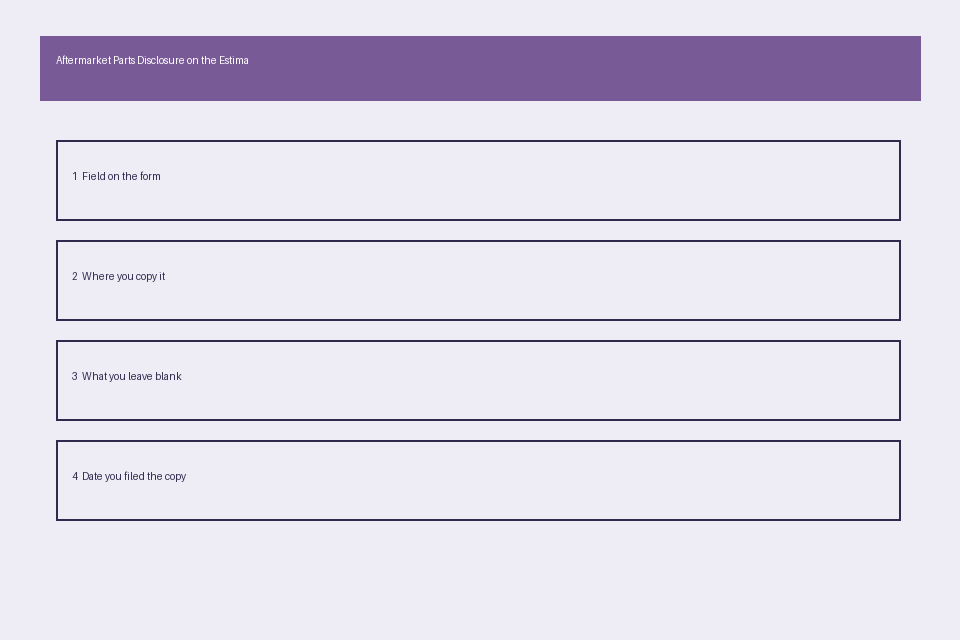
To simplify review of aftermarket part entries, your estimate should use standardized column alignment that groups all part origin information in a single, sortable column, with no mixed data across columns. The “Part Origin” column should be placed between the “Part Number” column and the “Part Description” column, so you can filter or sort all line items by origin code if you wish to review only aftermarket components without scrolling through OEM part lines. Additionally, the estimate must include separate subtotal lines for each part origin category, positioned below the full list of part line items and above the labor and materials subtotals. These separate subtotals must include line items for total OEM part cost, total new aftermarket part cost, total remanufactured part cost, and total recycled part cost, so you can easily see how much of the total estimated repair cost is allocated to each part type. Illustrative example: A $2,200 repair estimate might include subtotals of $510 for OEM parts, $720 for new aftermarket parts, $230 for remanufactured parts, and $180 for recycled parts, with the remaining $560 allocated to labor, paint materials, and shop supplies. If the estimate only includes a single combined “parts subtotal” without breaking out costs by origin, you can request a revised version of the document that includes these separate subtotals before you approve the repair, as this breakdown is often required to confirm coverage alignment with your auto insurance policy terms.
Supporting folder attachment rules for aftermarket part certification docs
All estimates that include aftermarket parts must be stored in your auto insurance claim folder with a set of supporting documentation to validate part quality and warranty coverage, per standard claim file organization best practices. First, you must attach a copy of the official certification document for every safety-related aftermarket part listed on the estimate; these documents must be specific to the exact part number listed, not generic certification paperwork for the manufacturer’s entire product line. Second, you must attach a copy of the manufacturer’s warranty document for every aftermarket part that includes warranty coverage, with a clear note linking the warranty to the corresponding part line on the estimate. Third, you must attach a signed copy of the first-page disclosure box acknowledgment, along with any written correspondence between you, the repair shop, and your insurance adjuster regarding requests for OEM parts or changes to part origin. You can use pre-printed folder tabs to separate these attachment categories for quick access, and you should also save digital scanned copies of all documents in a secure cloud storage location to avoid loss if physical copies are damaged or misplaced. If the repair shop cannot provide the required certification or warranty documents for listed aftermarket parts, you can request that the shop replace those parts with OEM or certified aftermarket alternatives before the repair work begins. This page is for educational purposes only, and does not bind coverage or determine claim eligibility; you can direct specific coverage questions to your insurance provider or licensed adjuster.
Before you sign your next auto repair estimate, cross-reference every listed part line against the parts-disclosure line card table on this page to confirm all mandatory origin fields are completed accurately.